Passato Prossimo Cheat Sheet: Essere or Avere Without Freezing
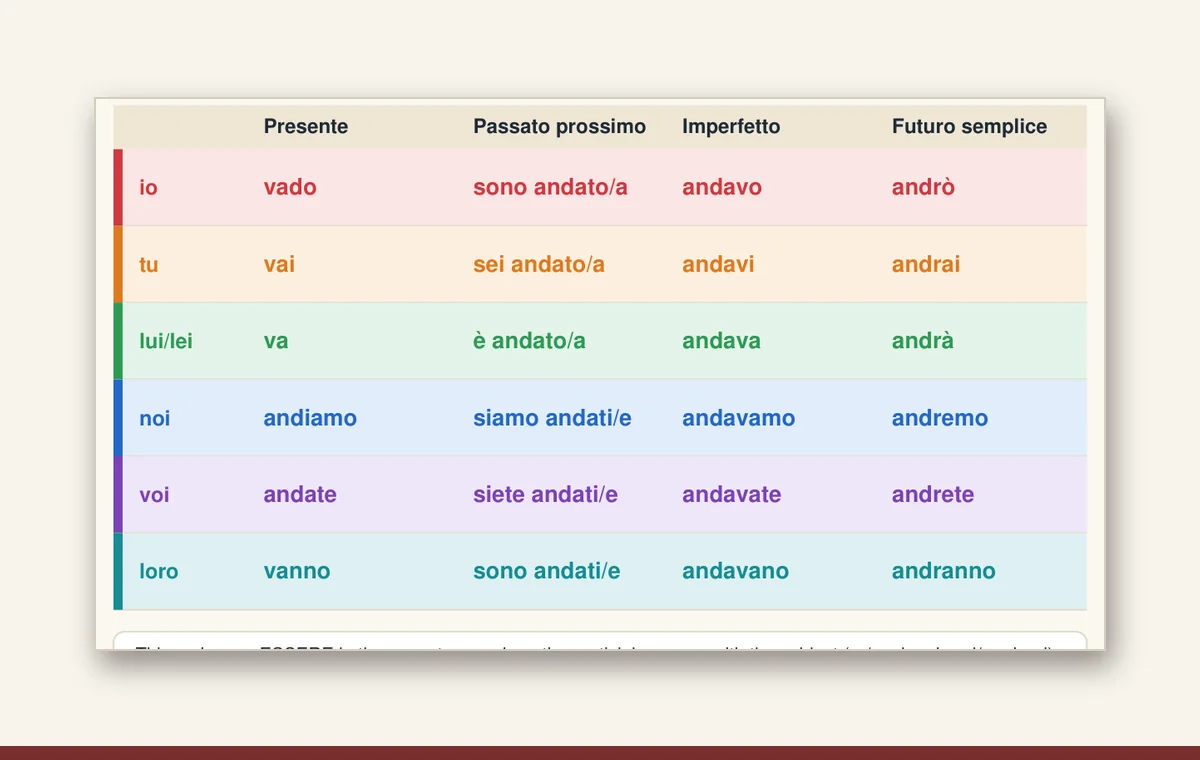
**Choosing between essere and avere is the moment most learners freeze: you have the verb, you know the sentence is in the past and then you have to pick a helper.** The fix is a short rule, a good habit and seeing the auxiliary every time you meet a verb. That is how each page in Verbi Chiari · Italian Verb Map Bundle is built. Below is the whole system on one page.
What the passato prossimo is made of
The passato prossimo has two pieces: a present-tense helper (essere or avere) and a past participle.
- "Ho mangiato." (I ate / I have eaten.)
- "Sono arrivata." (I arrived.)
That is all of it. Two decisions remain: which helper, and how to end the participle.
Step 1: Build the participle
| Family | Pattern | Example | Participle |
|---|---|---|---|
| -are | -ato | parlare | parlato |
| -ere | -uto | vendere | venduto |
| -ire | -ito | finire | finito |
Regular verbs are easy. Then there is a short list of very common irregular participles that you will hear all day. They are worth memorizing in pairs:
| Infinitive | Participle | Sentence |
|---|---|---|
| fare | fatto | Ho fatto la spesa. |
| vedere | visto | Ho visto un film. |
| prendere | preso | Ho preso il treno. |
| dire | detto | Ho detto di sì. |
| scrivere | scritto | Ho scritto un messaggio. |
| leggere | letto | Ho letto il menu. |
| aprire | aperto | Ho aperto la finestra. |
| mettere | messo | Ho messo il sale. |
| bere | bevuto | Ho bevuto un'acqua. |
Verbs such as essere have stato (sono stato/a). Avere has avuto (ho avuto).
Step 2: Pick the helper
Start from the default. Avere is the default. Transitive verbs, which take a direct object, use it: ho comprato un biglietto, abbiamo mangiato la pizza, hanno visto il mare. Many intransitive verbs also use it: ho dormito, ho lavorato, ho camminato.
Essere goes with verbs of movement and change of state, and with essere itself:
- andare: sono andato/a
- venire: sono venuto/a
- arrivare: sono arrivato/a
- partire: sono partito/a
- tornare: sono tornato/a
- entrare: sono entrato/a
- uscire: sono uscito/a
- rimanere: sono rimasto/a
- cadere: sono caduto/a
- stare: sono stato/a
- essere: sono stato/a
Read that list aloud a few times and it forms a picture: people going somewhere, arriving, leaving, staying or falling. If a verb describes a person traveling through a place or changing, think essere. If it describes doing something to something, think avere.
Step 3: Agree the participle with essere
When the helper is essere, the participle behaves like an adjective and matches the subject.
| Subject | Sentence |
|---|---|
| Marco | Marco è andato al mercato. |
| Maria | Maria è andata al mercato. |
| Marco e Luca | Sono andati al mercato. |
| Maria e Anna | Sono andate al mercato. |
| Marco e Maria | Sono andati al mercato. |
With avere, the participle stays the same: Maria ha mangiato, loro hanno mangiato. There is a further rule when a direct object pronoun comes before the verb ("Le ho viste"), but you can leave that for later.
The three mistakes to watch for
- Using avere with a movement verb. "Ho andato" sounds wrong to a native ear. It is sono andato/a.
- Forgetting agreement with essere. "Maria è andato" should be Maria è andata.
- Mixing with the imperfetto. The passato prossimo says what happened; the imperfetto sets the scene. "Mentre mangiavo, è arrivato Luca." The scene (mangiavo) is imperfetto, the event (è arrivato) is passato prossimo.
How the verb maps help
On every verb page in the bundle, the passato prossimo is written with its helper: ho finito, sono andato/a, abbiamo finito, siamo andati/e. You do not look up the auxiliary in a separate list; it is right there in the same row as the other three tenses. After thirty pages you have seen the choice made thirty times.
The master pattern chart then gives you the two-line rule, so you can handle a verb that is not among the 60.
Practice that takes five minutes
Take a sticky note. Write "Ieri..." and complete it with six verbs: mangiare, andare, vedere, arrivare, fare, uscire. The answers: Ieri ho mangiato, sono andato/a, ho visto, sono arrivato/a, ho fatto, sono uscito/a. Check each on its map. Repeat tomorrow with a different subject: "Ieri Maria...", "Ieri noi...".
What this sheet does not do
It does not cover every exception, such as verbs that can take either helper depending on meaning, or reflexive verbs, which take essere. Those are for a later stage. The aim here is to unblock your everyday sentences.
Why it is worth fixing now
Quick reference to keep on your desk
- Helper: avere by default; essere for movement and change (andare, venire, arrivare, partire, tornare, entrare, uscire, rimanere, cadere, stare, essere).
- Participle: -ato, -uto, -ito for regular verbs; learn fatto, visto, preso, detto, scritto, letto, aperto, messo, bevuto.
- Agreement: with essere, match the subject (andato, andata, andati, andate).
- Scene versus event: imperfetto for the background, passato prossimo for what happened.
Short drill to test yourself
Say these in the passato prossimo: "Io vado a Roma." (Sono andato/a a Roma.) "Noi mangiamo la pizza." (Abbiamo mangiato la pizza.) "Loro arrivano alle otto." (Sono arrivati alle otto.) "Tu fai la spesa." (Hai fatto la spesa.) "Lei parte presto." (È partita presto.) Score yourself, mark the helper and the participle separately and redo the ones you missed tomorrow.
Telling a day in the past
Put it all together in a short story, as you would tell it to a friend: Keep it simple and leave reflexive verbs for later. "Ieri sono uscito alle otto. Ho preso il treno. Sono arrivato a Milano alle dieci. Ho lavorato fino alle cinque. Poi ho mangiato con Luca e sono tornato a casa." Eight short sentences, five of them with avere and four with essere. Tell your own day this way each evening for a week and the choice of helper will stop being a choice.
The passato prossimo is the tense you need whenever you tell someone what you did: the trip, dinner, the call. Pick the helper without thinking and the rest of the sentence flows. **Look at the sample page above, where andare shows its essere helper in the same row as the other tenses, and imagine having that for 60 verbs.**