Italian Verb Conjugation Chart: One Verb, One Printable Page
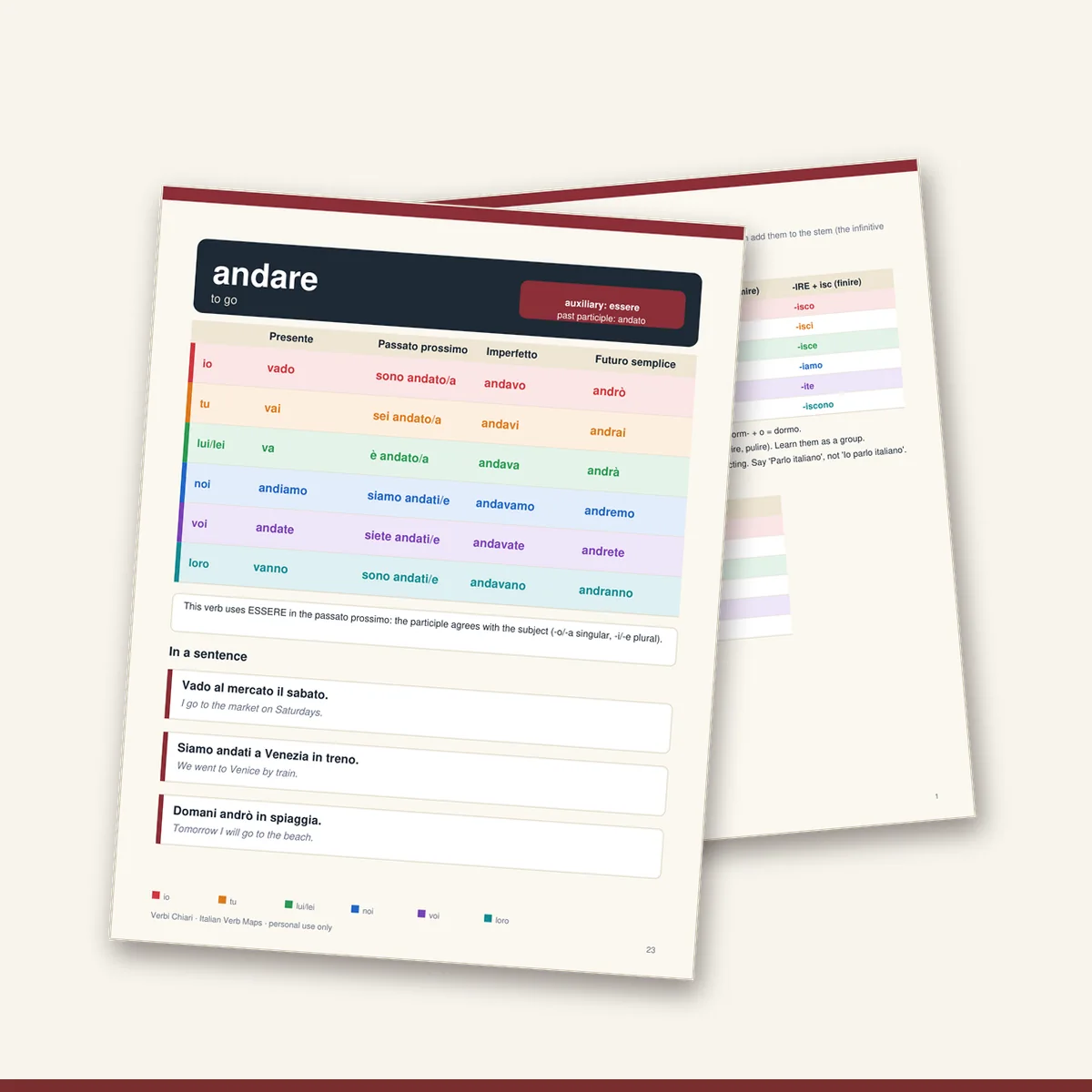
The most useful Italian conjugation chart is the one that shows a whole verb on a single page: four tenses, one color for each person and a few real sentences. That is the idea behind Verbi Chiari · Italian Verb Map Bundle, and this guide explains how to read such a chart, what to look for in one and how to use it so the endings finally stay with you.
Why most conjugation charts fail
Open any grammar book and the verb andare is split across several places. The present tense sits on one page, the passato prossimo three pages later and the future in a different chapter. You look up the form you need, close the book and forget it by the next day.
The second problem is that big tables are built for completeness, not for use. A full table shows every tense, including ones you will not need for months, so the four you actually say aloud get lost in the noise.
A good chart does the opposite. It picks the tenses you use in conversation, keeps them together and lets your eye find the person you need in a second.
What a good one-page chart shows
Take andare, "to go". On a verb map it looks like this in compact form:
| Person | Present | Passato prossimo | Imperfetto | Future |
|---|---|---|---|---|
| io | vado | sono andato/a | andavo | andrò |
| tu | vai | sei andato/a | andavi | andrai |
| lui/lei | va | è andato/a | andava | andrà |
| noi | andiamo | siamo andati/e | andavamo | andremo |
| voi | andate | siete andati/e | andavate | andrete |
| loro | vanno | sono andati/e | andavano | andranno |
Three things make this table useful rather than just correct.
- The auxiliary is part of the chart. Andare takes essere, so the passato prossimo shows sono andato/a and not just a participle. You see the helper and the ending agreement every time.
- Persons have colors. In the bundle, io, tu, lui/lei, noi, voi and loro each keep the same color on every page. After a dozen verbs your eye learns that the noi color always ends in -iamo in the present and that the tu color is where the verb is shortest.
- Sentences sit next to the forms. "Vado al mercato il sabato." "Siamo andati a Venezia in treno." "Domani andrò in spiaggia." Three lines that use the present, the passato prossimo and the future. The verb stops being a row in a table and becomes something you can say.
How to use the chart day to day
A chart only helps if it is in front of you at the moment you need it. These habits work best.
Print the verb you are about to use. Planning dinner out? Pull the pages for mangiare, prendere, volere and pagare. Read them once, say the three sentences aloud and leave them by your coffee.
Cover and recall. Fold the page so only the infinitive shows. Say the io and noi forms of the four tenses from memory, then unfold and check. This takes under a minute per verb and beats re-reading by a wide margin.
Follow the color. When a form surprises you, look at the color. Loro forms in the present almost always end in -ono or -ano: parlano, vedono, vanno. Seeing the same color pattern across pages teaches the system without a grammar lecture.
Keep a "mine" pile. Ten verbs cover a large share of daily talk. Put those pages in a folder and add one new verb a week.
The master chart behind the maps
Once the individual pages feel familiar, the master pattern chart in the bundle shows why so many verbs behave alike. Regular verbs fall into three groups by their ending:
| Group | Example | Present io | Present noi | Passato prossimo |
|---|---|---|---|---|
| -are | parlare | parlo | parliamo | ho parlato |
| -ere | vedere | vedo | vediamo | ho visto |
| -ire | finire | finisco | finiamo | ho finito |
The chart also gives essere and avere their own space, because they behave unlike anyone else and you need them in nearly every sentence. When you meet a new verb, you check its group and you already know most of what it will do.
What this chart does not claim
It is a study aid. Seeing a verb whole helps you recognize and review it, but fluency still depends on how much you speak, listen and practice. The bundle also keeps its focus on four tenses; the subjunctive and other tenses are outside it. If you want those later, they are available separately after your purchase.
Who will like it
- Self-taught learners who are tired of looking up the same verb every week.
- Travelers planning a trip who want to order, ask and chat without carrying a grammar book.
- Evening-class students who want a clean reference to put beside their textbook.
- Parents and grandchildren of Italian families who understand more than they can say and want the verbs in order.
A first week with the chart
Day one, read the Start Here guide and the master pattern chart. Day two, work through essere and avere. Day three, andare and fare. Day four, volere, potere and dovere. Day five, three regular verbs: parlare, vedere and finire. Weekend, make your own sentences with each color of person. By the end you will have seen ten verbs whole, and you will know which of them follow the rule and which break it.
Printing tips
Print in color if you can, because the person colors do the teaching. On black and white, use a light highlighter on the io and noi columns. Punch holes and keep the maps in a slim binder, or slide a page into a clear sleeve and write on it with a dry-erase marker for cover-and-recall practice.
Reading a chart as a learner
Start with the person colors. Pick any color and follow it down the four columns. You will find that each color holds a family of endings: the noi color is full of -iamo, -emo, -avamo, the loro color of -ano, -ono, -anno. This is a lesson on its own: before you can recall a form, you recognize its shape. Doing this with a different verb each day will, within a few weeks, make new verbs feel familiar before you have studied them.
Compare two verbs
Open the pages for parlare and vedere side by side. Run your finger along the noi row: parliamo, abbiamo parlato, parlavamo, parleremo and vediamo, abbiamo visto, vedevamo, vedremo. The endings of the imperfetto match (-avamo, -evamo), the future differs only in the stem, and the helper is the same. Ten seconds of comparison tells you more about how Italian works than a paragraph of rules.
Verb charts are not glamorous, but a good one saves you minutes every day and gives you the confidence to start the sentence. Use the sample page above to see how one verb looks, then decide whether the full set of 60 fits the way you study.