Italian Verbs Cheat Sheet: The Patterns Worth Printing
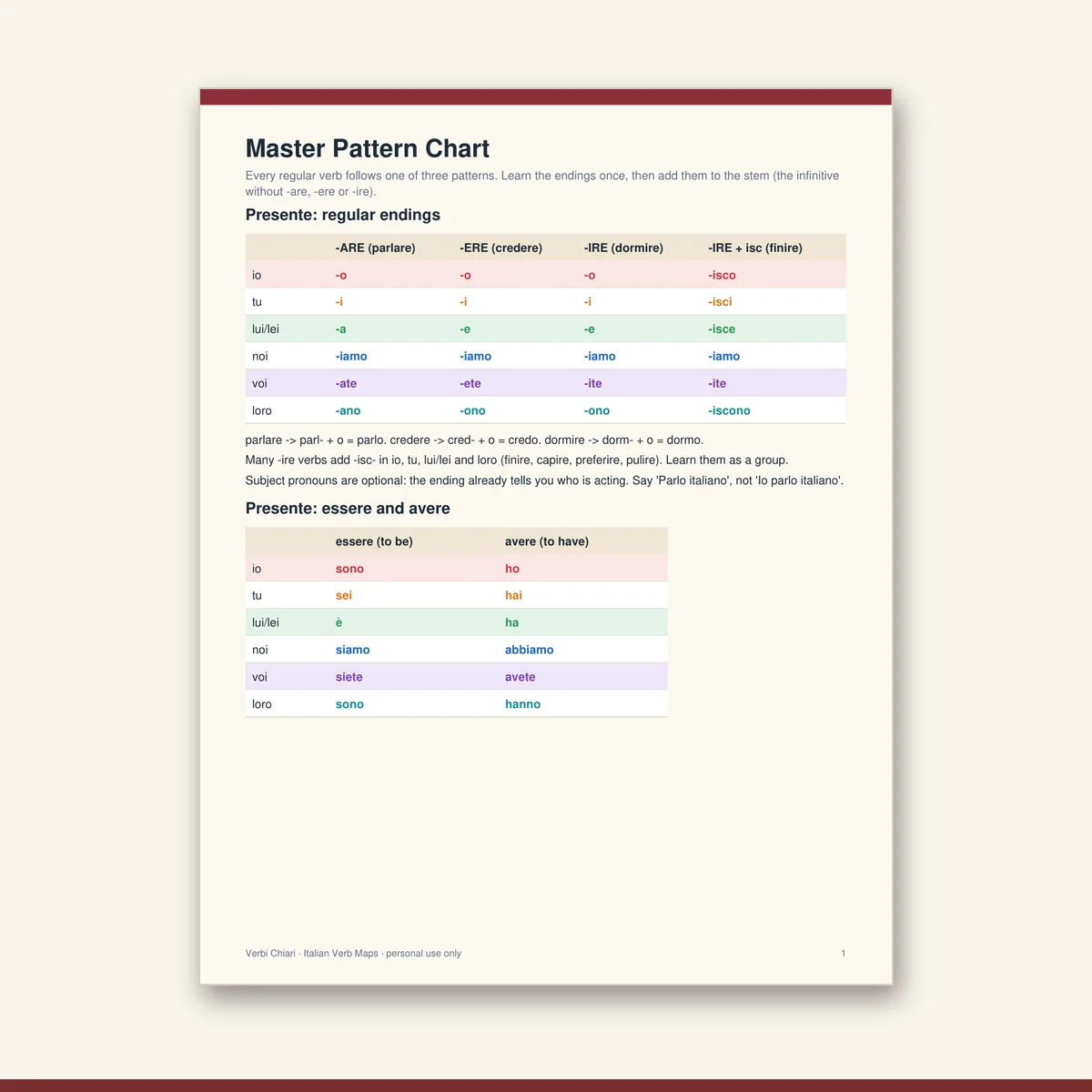
A useful Italian verbs cheat sheet is not a list of verbs, it is a map of patterns: three regular endings, two exceptions you cannot avoid and a handful of habits that tell you which form to pick. The master pattern chart in Verbi Chiari · Italian Verb Map Bundle is built exactly that way. Here is what belongs on such a sheet and how to use it without it turning into a wall of text.
Start with the three families
Almost every Italian verb ends in -are, -ere or -ire. That ending is the family, and the family decides how the verb changes. Here is the present tense of one verb from each.
| parlare (-are) | vedere (-ere) | dormire (-ire) | |
|---|---|---|---|
| io | parlo | vedo | dormo |
| tu | parli | vedi | dormi |
| lui/lei | parla | vede | dorme |
| noi | parliamo | vediamo | dormiamo |
| voi | parlate | vedete | dormite |
| loro | parlano | vedono | dormono |
Notice how much is shared. The noi form always ends in -iamo. The io form ends in -o. The tu form ends in -i for all three families. A cheat sheet should make these shared bits obvious so that you learn eight or nine endings and not eighteen.
There is one important twist. Many -ire verbs insert -isc- in some persons: finire gives finisco, finisci, finisce, finiamo, finite, finiscono. A good sheet flags which -ire verbs do this (finire, capire, preferire, pulire) and which do not (dormire, partire, sentire, aprire).
The two exceptions you cannot skip
Essere ("to be") and avere ("to have") are the most used verbs in the language and follow no family.
| essere | avere | |
|---|---|---|
| io | sono | ho |
| tu | sei | hai |
| lui/lei | è | ha |
| noi | siamo | abbiamo |
| voi | siete | avete |
| loro | sono | hanno |
They matter twice. They are verbs in their own right ("Sono stanca", "Ho fame"), and they are the helpers that build the passato prossimo. If you only memorize one block of your cheat sheet, make it this one.
The auxiliary rule in one line
The passato prossimo is the helper plus a past participle: ho mangiato, sono arrivata. Most verbs take avere. Verbs of movement and change of state, such as andare, venire, arrivare, partire, tornare, uscire and rimanere, take essere, and then the participle agrees with the subject: Marco è andato, Maria è andata, siamo andati.
On a cheat sheet this fits in two lines. On a verb map it goes further, because the auxiliary shows next to every verb.
The tenses to put on it
For speaking, four tenses carry most of the weight:
- Present: what you do and what is true now. "Lavoro a Milano."
- Passato prossimo: what you did. "Ieri ho mangiato la pizza."
- Imperfetto: what you used to do, or the scene in the background. "Da piccolo andavo al mare ogni estate."
- Future: what you will do. "Domani andrò in spiaggia."
The sheet should show all four for the same verb, side by side, so you see the stem change. Andare keeps its stem in the imperfetto (andavo) and uses andr- in the future (andrò). That pattern, a changed stem in the future, repeats with avere (avrò), potere (potrò), vedere (vedrò) and fare (farò).
What makes one sheet better than another
A cheat sheet earns a place on your wall when it passes a few tests.
It fits one glance. If you have to scroll or search, you will not use it in the middle of a sentence.
It uses color for the person. After a few days your brain links a color with noi and another with loro, and finding a form stops being a hunt.
It shows sentences. A form alone is a fact. A sentence is a skill. "Voglio un caffè, per favore." "Posso pagare con la carta?" Short lines like these are what you will actually say.
It tells you what it leaves out. The bundle covers four tenses and the most useful 60 verbs. It does not pretend to be a complete grammar.
How to use it with the verb maps
Use the master chart as the index and the verb maps as the detail.
- Meet a new verb in a song, a menu or a conversation.
- Check its family on the master chart.
- If the verb is among the 60, open its map and read the four tenses together. If it is not, apply the family pattern and note any surprises.
- Say the three example sentences, then write one of your own.
After a few weeks, the chart on your desk becomes a check rather than a crutch. You glance at it only to confirm what your ear already expects.
A ten-minute routine
Minutes one to three: write the io and noi forms of the present for one verb from each family on a scrap of paper. Minutes four to six: check against the chart and circle your slips. Minutes seven to ten: make a sentence for each with the passato prossimo. Done daily, this fixes the families faster than reading a chapter once.
What to expect
Common slips the sheet should catch
- Saying noi parlamo: the noi form is always -iamo, so parliamo.
- Forgetting the -isc- in finire: it is finisco, not fino.
- Mixing -ere and -ire in the voi form: vedete but dormite.
- Using avere with andare in the past.
- Leaving out the accent on è when you write "è stanca".
Keep this list at the bottom of your sheet and cross out each slip as it stops happening.
Build your own back page
The best cheat sheet has a back side that is yours. Write the five forms that trip you up most and the sentence in which you want to use them. Change it every two weeks. A personal list of five items beats a generic list of fifty because it targets what you actually get wrong.
A cheat sheet will not teach you to speak. It will take away the friction that makes you stop mid-sentence, so that you can spend your effort on listening and talking. See the master chart page above, then decide whether having it together with the 60 maps is the quick reference you have been missing.