The Best Way to Learn Italian Verbs: See Each One Whole
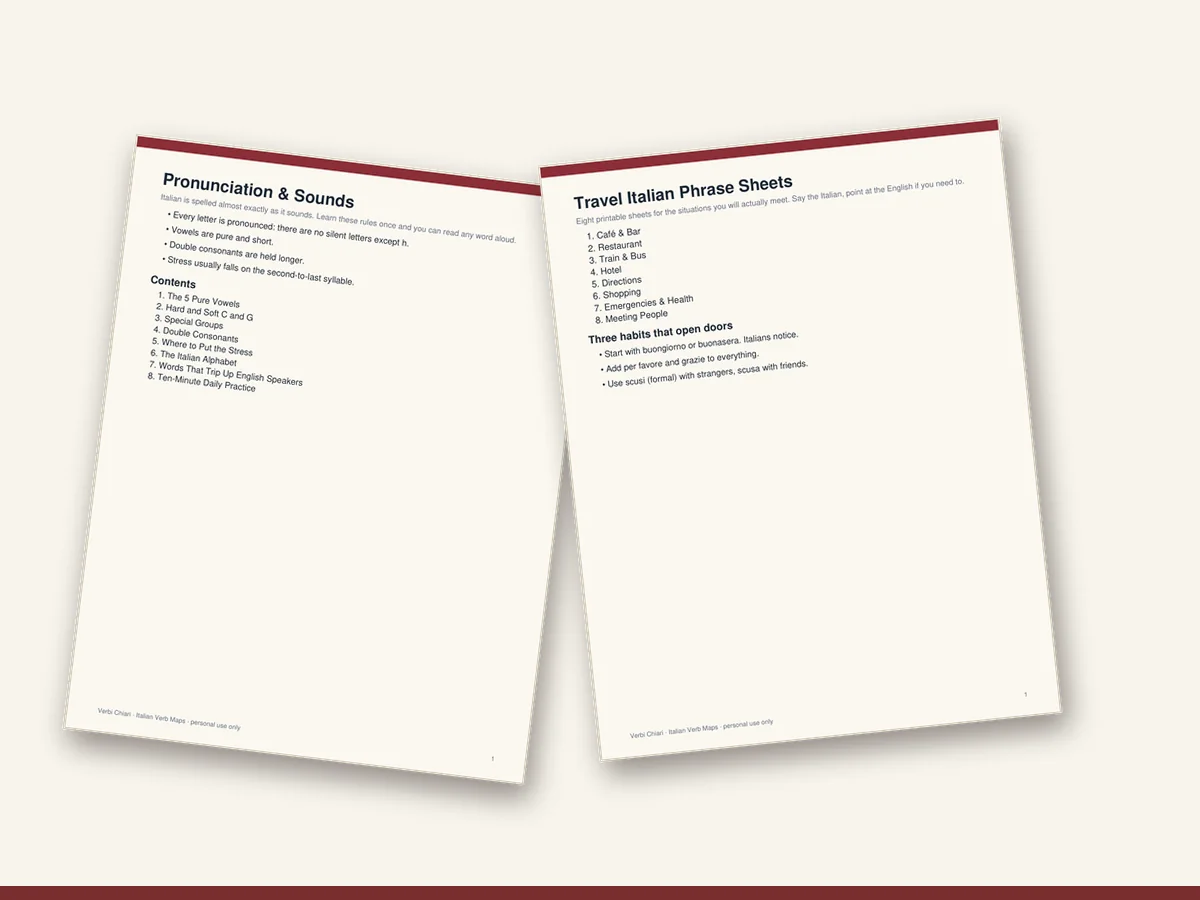
The best way to learn Italian verbs is to stop studying them in pieces: see each verb whole, learn the patterns first, and use every verb in a sentence of your own. That sounds simple, and it is. What makes it hard is that most materials scatter the pieces. This guide gives you a method that fits ten minutes a day, with the verb maps in Verbi Chiari · Italian Verb Map Bundle as the working tool.
Where the usual approach breaks down
Most learners meet verbs in three places, each with its own gap.
- Tables. Complete, but split by tense. You rarely see one verb in full, and you look up the same form again and again.
- Apps. They are good at repetition, but they mark an answer right or wrong without showing how the whole verb fits together.
- Classes. A chapter on the passato prossimo, a different one on the future, weeks apart. By the time you reach the second, the first has faded.
The problem is not your memory. It is that nobody shows you each verb in one place. Fix that, and the effort you already spend goes much further.
Principle 1: One verb, all tenses
Pick a verb and look at the four tenses you will actually speak in: present, passato prossimo, imperfetto and future. For volere:
| Person | Present | Passato prossimo | Imperfetto | Future |
|---|---|---|---|---|
| io | voglio | ho voluto | volevo | vorrò |
| tu | vuoi | hai voluto | volevi | vorrai |
| lui/lei | vuole | ha voluto | voleva | vorrà |
| noi | vogliamo | abbiamo voluto | volevamo | vorremo |
| voi | volete | avete voluto | volevate | vorrete |
| loro | vogliono | hanno voluto | volevano | vorranno |
Seen together, the odd stem in the present (vogl-) and the future (vorr-) stands out, and the imperfetto reveals itself as the regular one. You learn the verb's personality, not twenty isolated forms.
Principle 2: Patterns before exceptions
Regular verbs fall into three families. If you know that the noi form ends in -iamo in all of them, and that the tu form ends in -i, you have already cut your work in half. Only then do you go to the exceptions. The master pattern chart in the bundle lays the three families side by side for that purpose.
Principle 3: Color helps your eye
Give each person its own color and keep it the same on every page. After a handful of verbs, you recognize loro by its color before you read it. This sounds like a small thing and it removes the scanning that makes tables tiring.
Principle 4: Sentences, not cards
A form alone is easy to forget. A form in a sentence about your life is not. For every verb, say or write three sentences: one in the present, one in the past and one in the future.
- "Vado al mercato il sabato."
- "Ieri sono andata al mercato."
- "Domani andrò al mercato."
The verb maps give you three examples as models, so you are never starting from a blank page.
Principle 5: Little and often
Ten minutes a day beats an hour on Sunday. A good rhythm:
- Minutes 1 to 2: read the page for today's verb.
- Minutes 3 to 5: cover and recall the io and noi forms.
- Minutes 6 to 8: say the three example sentences aloud.
- Minutes 9 to 10: write one sentence of your own.
A four-week starter plan
| Week | Verbs | Goal |
|---|---|---|
| 1 | essere, avere, andare, fare | Say where you are, what you have, where you go, what you do |
| 2 | volere, potere, dovere, stare | Ask, offer, explain, say how you are |
| 3 | parlare, mangiare, comprare, pagare | See the regular -are pattern in action |
| 4 | vedere, prendere, finire, partire | Meet the other two families |
After week four, review all sixteen with cover and recall before adding more.
Mix in listening and speaking
The method works best with sound. Read your example sentences aloud. Listen to a short Italian podcast or song and listen for the verb of the day. When you hear vado or vuoi, you will notice it, and that tiny moment of recognition is learning at work.
Keep expectations honest
A printed method is a study aid. It helps you see and review verbs. It does not replace speaking with someone, and it does not promise fluency in a number of days. What it does is remove the friction that makes people stall: looking things up, forgetting the helper, losing the thread between tenses.
Common mistakes
- Trying to learn the whole table at once. One verb, four tenses, ten minutes.
- Skipping essere and avere. They appear everywhere, including as helpers.
- Never producing sentences. Reading is not enough; say and write.
- Ignoring the auxiliary. Ho andato is a classic slip; it is sono andato/a.
What a good week looks like
Monday: essere, present and passato prossimo. Tuesday: avere, same. Wednesday: andare, with attention to the helper in "Sono andato al mercato". Thursday: fare, where the irregular stem facc- shows up in "Faccio colazione alle otto". Friday: review the four verbs with cover and recall, and write two sentences for each. Weekend: listen to anything in Italian for ten minutes and write down every verb you recognize.
At the end of the week you will not have mastered four verbs, but you will have seen each one whole, said it aloud and used it in your own sentences. That is a stronger start than twenty verbs read once. Over a month, a rhythm like this adds up to sixteen verbs that you can use, plus the habit of studying that makes the next sixteen easier.
How to know it is working
Notice small signs. You stop reaching for the table to check vuoi or puoi. You hear vado in a song and recognize it as part of andare. You start a sentence in the past and the helper comes without a pause. Those are the signs that a form has moved from your page to your ear. When a verb produces them, move its page to your "known" pile and review it once a month.
Start with the Start Here page above to see the order the bundle suggests, then decide whether 60 verb maps fit the way you want to study.