Italian Irregular Verbs Chart: Learn the Few That Matter
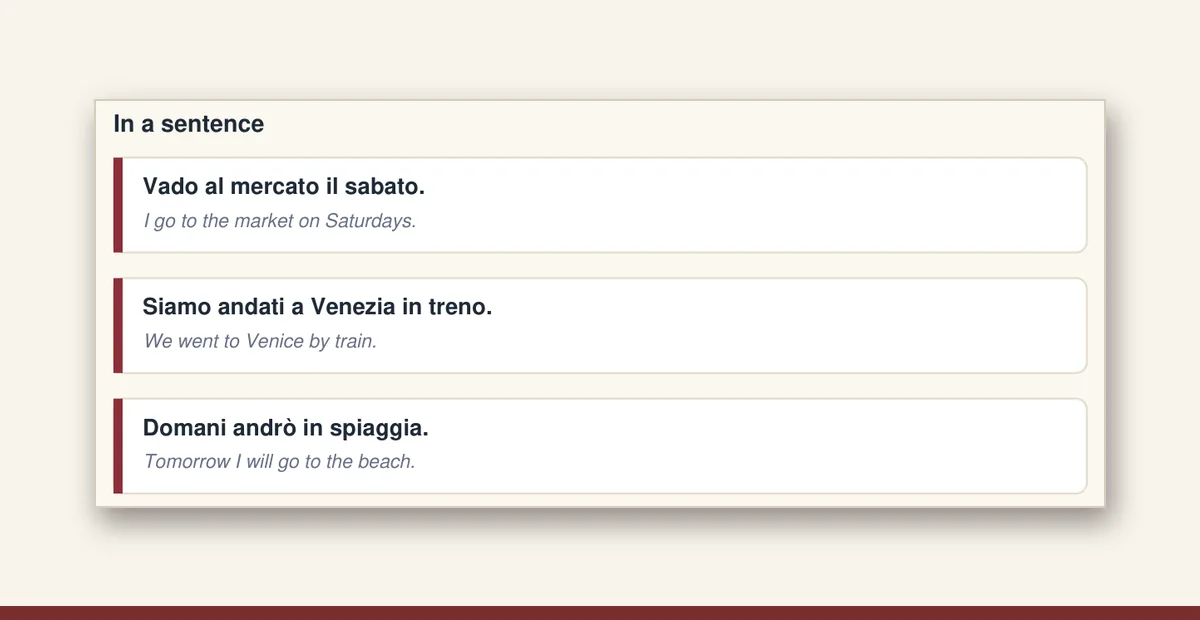
Italian irregular verbs look scary on a list, but the ones you really need are about twenty, and they repeat the same few tricks. Learn those tricks and the verbs themselves, and most of the language opens up. This chart groups them by what changes, and shows how the verb pages in Verbi Chiari · Italian Verb Map Bundle keep every irregular form where you can see it.
The irregular present tense
The verbs most used in the present are mostly irregular. Here are the key ones side by side.
| essere | avere | andare | fare | stare | dare | |
|---|---|---|---|---|---|---|
| io | sono | ho | vado | faccio | sto | do |
| tu | sei | hai | vai | fai | stai | dai |
| lui/lei | è | ha | va | fa | sta | dà |
| noi | siamo | abbiamo | andiamo | facciamo | stiamo | diamo |
| voi | siete | avete | andate | fate | state | date |
| loro | sono | hanno | vanno | fanno | stanno | danno |
| volere | potere | dovere | sapere | venire | dire | bere | uscire | |
|---|---|---|---|---|---|---|---|---|
| io | voglio | posso | devo | so | vengo | dico | bevo | esco |
| tu | vuoi | puoi | devi | sai | vieni | dici | bevi | esci |
| lui/lei | vuole | può | deve | sa | viene | dice | beve | esce |
| noi | vogliamo | possiamo | dobbiamo | sappiamo | veniamo | diciamo | beviamo | usciamo |
| voi | volete | potete | dovete | sapete | venite | dite | bevete | uscite |
| loro | vogliono | possono | devono | sanno | vengono | dicono | bevono | escono |
Look for the pattern. The noi and voi forms are often closer to regular than the others, and the io and loro forms frequently share a changed stem: vengo, vengono; dico, dicono; esco, escono. When you see this, you know where to look.
The irregular participle
For the passato prossimo, these participles are worth knowing by heart:
| Infinitive | Participle | Helper | Example |
|---|---|---|---|
| essere | stato | essere | Sono stata a Roma. |
| avere | avuto | avere | Ho avuto un'idea. |
| fare | fatto | avere | Abbiamo fatto una passeggiata. |
| dire | detto | avere | Ha detto di no. |
| vedere | visto | avere | Ho visto Luca. |
| prendere | preso | avere | Hai preso il caffè? |
| scrivere | scritto | avere | Ho scritto una cartolina. |
| leggere | letto | avere | Hanno letto il libro. |
| venire | venuto | essere | Sono venuta in treno. |
| rimanere | rimasto | essere | Siamo rimasti a casa. |
| scegliere | scelto | avere | Ho scelto il vino. |
| bere | bevuto | avere | Hai bevuto l'acqua? |
Regular verbs follow -ato, -uto, -ito. The irregulars shown above are mostly -ere verbs, and many end in -tto or -sto. That helps you to guess: scritto, detto, fatto, letto all have a double t.
The irregular imperfetto
The imperfetto is the friendliest tense. Nearly everything is regular: parlavo, vedevo, dormivo. A few verbs use an older stem:
- essere: ero, eri, era, eravamo, eravate, erano
- fare: facevo, facevi, faceva, facevamo, facevate, facevano
- dire: dicevo, dicevi, diceva, dicevamo, dicevate, dicevano
- bere: bevevo, bevevi, beveva, bevevamo, bevevate, bevevano
That is nearly the whole list for daily use. Example: "Quando ero piccola, abitavo a Torino."
The irregular future
Future stems are the biggest source of surprises. Most regular verbs form the future from the infinitive (parlerò, vedrò). Some shorten it, and the rest of the ending is regular (-ò, -ai, -à, -emo, -ete, -anno).
| Infinitive | Future io | Future noi |
|---|---|---|
| essere | sarò | saremo |
| avere | avrò | avremo |
| andare | andrò | andremo |
| fare | farò | faremo |
| potere | potrò | potremo |
| dovere | dovrò | dovremo |
| volere | vorrò | vorremo |
| venire | verrò | verremo |
| bere | berrò | berremo |
| sapere | saprò | sapremo |
| vedere | vedrò | vedremo |
Spot the logic: many of these drop the vowel of the infinitive ending (avere gives avr-, andare gives andr-), and a few drop more (volere gives vorr-, venire gives verr-). Say them out loud a few times and they begin to feel natural.
Why the order of attack matters
Do not try to learn the whole chart at once. Take one block a week.
- Present of essere, avere, andare, fare. Nothing else is used more.
- Modals: volere, potere, dovere, sapere. You will use them to ask, to offer and to refuse.
- Participles of the same verbs. You need them to talk about yesterday.
- Future stems. Last, because the future is the easiest to avoid at first.
How the verb maps handle exceptions
On a verb map, the exceptions sit in the same layout as the regular verbs, with the same colors for the same persons. That is deliberate. When the io form of venire is vengo, you see that the color for io is the one that breaks the pattern, and the color for loro breaks with it. The system teaches you where irregularities live. The three example sentences then put the irregular form in real use: "Vado al mercato il sabato", "Siamo andati a Venezia in treno".
A quick daily test
Pick two verbs from the chart. Without looking, say the present, participle with helper and future for io. For venire: vengo, sono venuto/a, verrò. For bere: bevo, ho bevuto, berrò. Check against the page. If you slip, circle it.
What it does not promise
An irregular chart will not make the verbs automatic by itself. Repetition in speech and listening does. It is a way to see the system, shorten the search and know which forms deserve your repetition.
Memory tricks that help
Group by shape, not by alphabet. Verbs in -ere with a double t in the participle (fatto, detto, scritto, letto) share a look. Verbs with a -g- in the io and loro forms (vengo, vengono; rimango, rimangono; scelgo, scelgono) form another group. Verbs with a short future stem (avr-, andr-, potr-, vedr-, dovr-) are a third.
Write each group on its own index card and recite it once a day for a week. Groups are easier to recall than separate facts, and each time you meet a new verb you can ask which group it belongs to.
**See the sample map above for andare, and think about having each of the irregular verbs on a page with its helper, stems and example lines.**