Most Common Italian Verbs: The 60 Worth Printing First
A short list of the right verbs does more for your Italian than a long list of everything. Spoken Italian leans on a small group of verbs again and again, so learning those well pays back in every conversation. This guide groups the ones that matter into useful sets and shows how the 60 maps in Verbi Chiari · Italian Verb Map Bundle turn each into something you can say.
Why the shortlist works
Think about what you say on an ordinary day: where you are going, what you want, what you can or have to do, what you have and what you did. The verbs behind those sentences are the same small group, whether you are ordering lunch or talking about the weekend. Mastering them early means most of your sentences work, even with a limited vocabulary.
Group 1: The foundation
| Verb | Meaning | Example |
|---|---|---|
| essere | to be | Sono stanca. |
| avere | to have | Ho una domanda. |
| stare | to stay, to be (well) | Come stai? Sto bene. |
| fare | to do, to make | Faccio colazione alle otto. |
| andare | to go | Vado al lavoro in treno. |
| venire | to come | Vieni anche tu? |
| dare | to give | Mi dai il sale? |
These seven verbs are irregular, and they are used in thousands of sentences. Treat them as vocabulary and learn each one whole.
Group 2: The modals
| Verb | Meaning | Present io | Present noi |
|---|---|---|---|
| volere | to want | voglio | vogliamo |
| potere | to be able to | posso | possiamo |
| dovere | to have to | devo | dobbiamo |
| sapere | to know a fact, to know how | so | sappiamo |
They are followed by another verb in the infinitive: "Voglio mangiare", "Posso pagare con la carta?", "Dobbiamo partire presto." With these four, you can ask, request, offer and explain. Note the future stems: vorrò, potrò, dovrò, saprò.
Group 3: Everyday regular -are verbs
Parlare, mangiare, cercare, pagare, lavorare, aspettare, abitare, comprare, guardare, ascoltare, trovare, chiamare, pensare, studiare, viaggiare, cominciare, imparare, giocare.
They all follow the same present pattern: -o, -i, -a, -iamo, -ate, -ano. Learn parlare and you can conjugate the rest. Watch the spelling shifts in mangiare (mangi, mangerò) and pagare (paghi, pagherò), which keep the sound of the stem.
Group 4: Everyday -ere and -ire verbs
-ere: vedere, credere, vendere, prendere, scrivere, leggere, chiedere, mettere, vivere, conoscere, rispondere.
-ire: dormire, partire, sentire, aprire, capire, finire, preferire, uscire, offrire, pulire, seguire, servire.
Two details to catch. Capire, finire, preferire and pulire add -isc- in the present (capisco, preferiscono). And uscire is irregular: esco, esci, esce, usciamo, uscite, escono.
Group 5: Verbs of movement and change
Arrivare, tornare, entrare, andare, partire, uscire, rimanere, cadere. They are the essere verbs: sono arrivato/a, sono tornato/a. Learning them as a set means you do not hesitate on the auxiliary.
What a verb map adds to the list
A list tells you a verb exists. A map shows you what it does. For fare:
| Person | Present | Passato prossimo | Imperfetto | Future |
|---|---|---|---|---|
| io | faccio | ho fatto | facevo | farò |
| tu | fai | hai fatto | facevi | farai |
| lui/lei | fa | ha fatto | faceva | farà |
| noi | facciamo | abbiamo fatto | facevamo | faremo |
| voi | fate | avete fatto | facevate | farete |
| loro | fanno | hanno fatto | facevano | faranno |
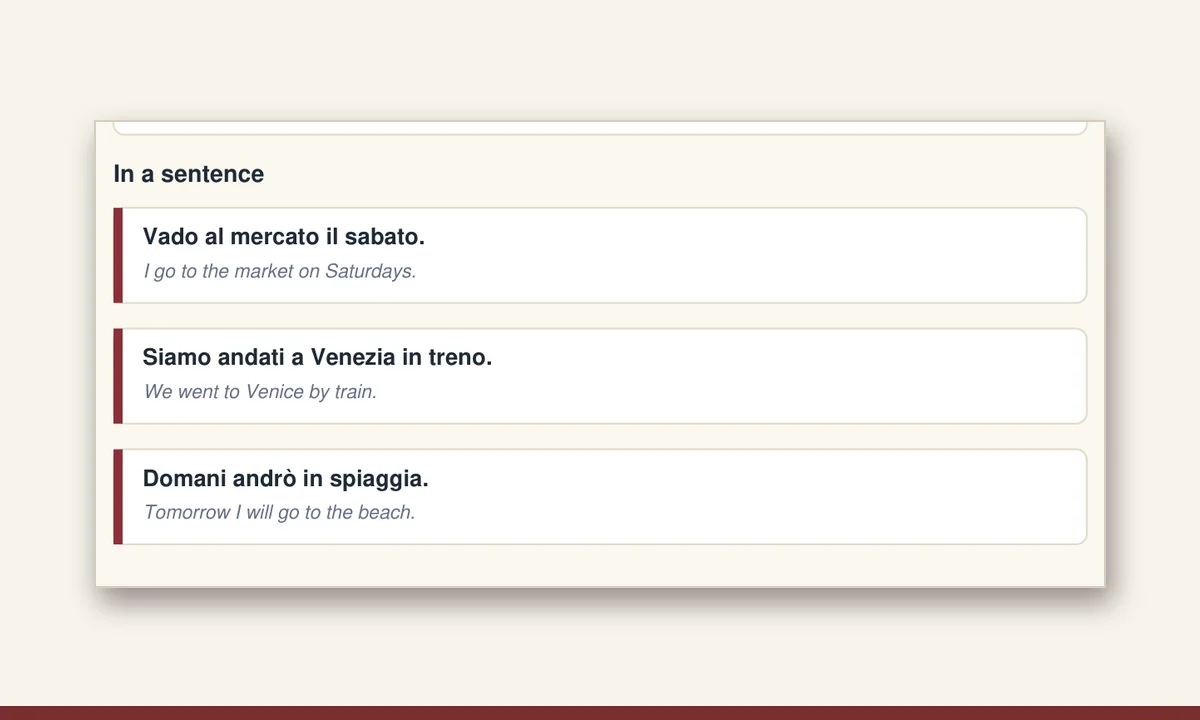
Plus three example sentences and a color for each person. A single page replaces a long search through a grammar book.
A suggested order
- Week 1: essere, avere, andare, fare.
- Week 2: volere, potere, dovere, stare.
- Week 3: parlare, mangiare, comprare, pagare.
- Week 4: vedere, prendere, scrivere, leggere.
- Week 5: finire, capire, partire, uscire.
- Weeks 6 and beyond: add four a week, and revisit the old ones.
The Start Here guide in the bundle lays out an order like this, so you do not have to design it yourself.
Use the list in real life
Pick the day's verb and use it three times before bed: once in your head while doing something ("Preparo la cena"), once aloud ("Prendo un caffè") and once in writing ("Domani vado a Roma"). Three contacts in different forms beat ten silent re-reads.
What 60 verbs will not do
They are a core, not the whole language. You will still need vocabulary, listening and speaking. And the bundle covers four tenses; the subjunctive and other moods are not in it. What it gives you is a stable base of the verbs people reach for first, with the patterns that carry over to new ones.
Print the first ten
Reading the list as a plan
Do not read the groups as a vocabulary test. Read them as a plan for your first two months. In month one, you cover the foundation and the modals, because they unlock everything else. In month two, you take the regular verbs by family, using one example from each as a model and the others as practice. By then you will have met the patterns often enough that new verbs hold few surprises.
Keep a running tally of verbs you can use in a full sentence in each tense. That number matters more than the number of verbs you have merely read. Twenty verbs you can use beat sixty you have seen once.
Three quick checks
Can you say the io form of every verb in Group 1 without looking? Can you name the helper for each verb in Group 5? Can you make a sentence with each modal and an infinitive, like "Devo finire il lavoro"? If the answer is yes to all three, you are ready to add the next group. If not, spend another week where you are. A slower start gives a steadier base, and the verbs return the favor in every later lesson.
You do not need all 60 on paper. Print the foundation and modal verbs first, keep them in a folder next to where you study and add new pages as you go. Look at the sample page above and picture having the whole set, one verb per page.