Italian Vocabulary Sheets (Printable): Themes That Pair With Your Verbs
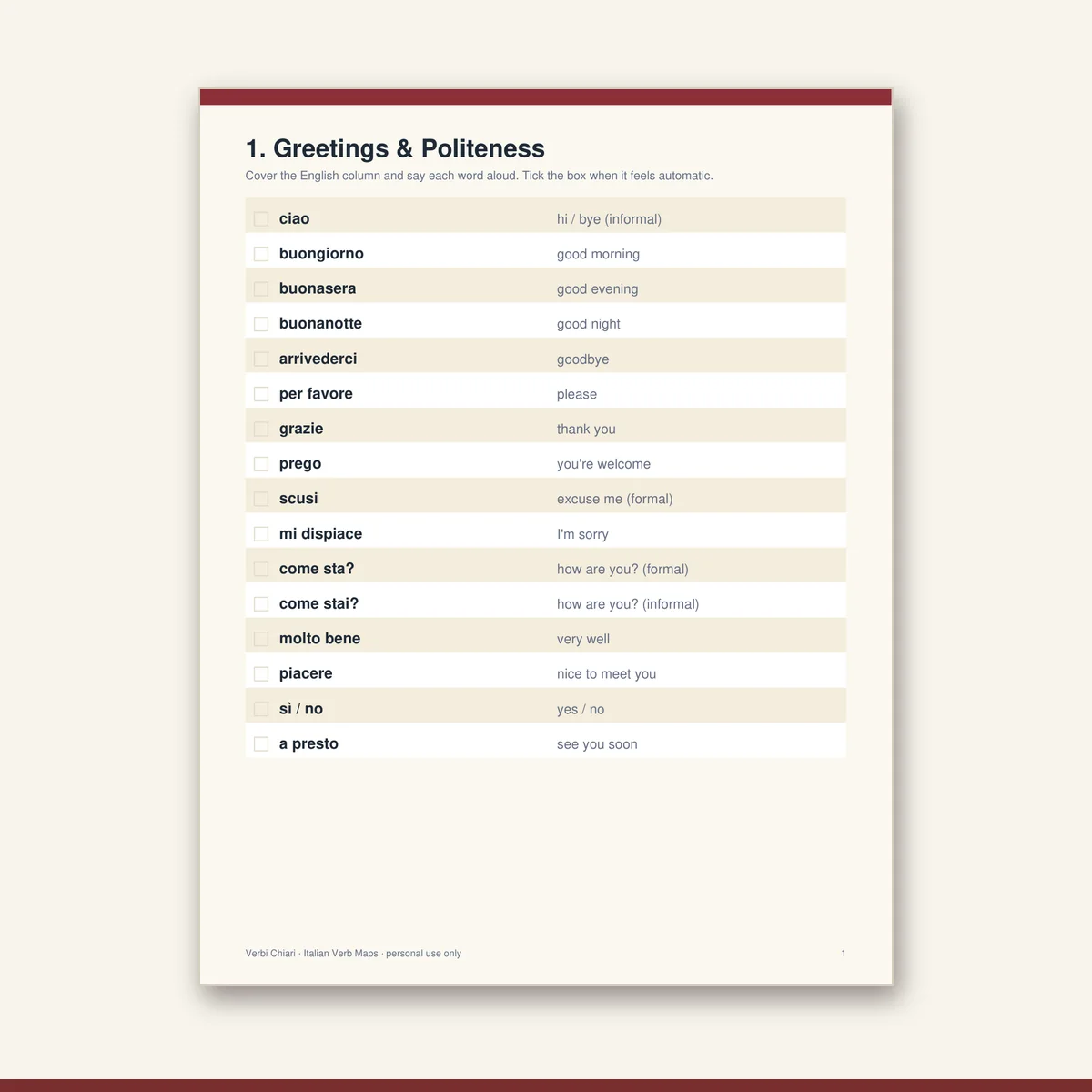
A vocabulary sheet is most useful when each theme sits next to the few verbs you need to talk about it. Words on their own pile up and fade; words with a verb become sentences. Verbi Chiari · Italian Verb Map Bundle includes 20 themed sheets for exactly that reason, and this guide shows how to use them with the verb maps so that food, travel and home turn into things you can say.
What a themed sheet is for
Open any phrasebook and you find long lists: fruits, colors, rooms. They are tidy and they do little for you at the table. What you need in a restaurant is not "la mela" in isolation; it is "Vorrei una mela", "Prendo una mela", "Mangio una mela".
A themed sheet works as a cue card. You print one for a situation, keep it in sight and build sentences from it with a short list of verbs. The sheets in the bundle cover everyday and travel topics, among them food, travel, home and people.
Pairing a theme with verbs
Here is how the pairing works in practice.
| Theme | Core verbs | Sentence |
|---|---|---|
| At the restaurant | volere, prendere, bere, mangiare, pagare | Prendo un caffè. Vorrei pagare. |
| At the station | andare, partire, arrivare, comprare | Vado a Firenze. Il treno parte alle nove. |
| At home | abitare, dormire, cucinare, pulire | Abito a Boston. Dormo bene. |
| People | essere, avere, chiamarsi, conoscere | Ho due fratelli. Conosco Marco. |
| Shopping | cercare, comprare, vedere, costare | Cerco un regalo. Compro il pane. |
| Work | lavorare, finire, cominciare, chiamare | Lavoro dal lunedì al venerdì. |
Notice the same verbs appearing in several themes: volere, prendere, andare, avere. That is why the 60 verbs come first. They are the hinge for every vocabulary sheet.
Method: five words, three verbs, one scene
Choose a theme and set a tiny target.
- Pick five nouns from the sheet. For food: il pane, il caffè, l'acqua, la pizza, il vino.
- Pick three verbs from your maps: volere, prendere, mangiare.
- Make nine sentences, one noun with each verb.
- Say them aloud as if you were at the counter.
For instance: "Voglio il caffè." "Prendo la pizza." "Mangio il pane." Then switch persons: "Vogliamo l'acqua", "Prendete il vino?"
This takes ten minutes and gives you sentences you can use the same week.
Building in the past and future
Once the present feels solid, move the same scene into the passato prossimo and the future, using the verb pages as your guide.
- Present: "Prendo un caffè."
- Passato prossimo: "Ieri ho preso un caffè."
- Future: "Domani prenderò un caffè."
The sheet supplies the noun, the verb map the forms. The two together make the whole phrase available.
A trip, planned by theme
Suppose you leave in six weeks. A plan:
| Stage | Theme sheet | Verbs to rehearse |
|---|---|---|
| First | Food | volere, prendere, mangiare, bere |
| Second | Travel | andare, partire, arrivare, comprare |
| Third | People | essere, avere, conoscere, chiamare |
| Fourth | Home and stay | abitare, dormire, stare, trovare |
| Fifth | Shopping | cercare, comprare, pagare, vedere |
| Sixth | Mixed review | Pick the weak spots |
You do not need all 20 sheets for a trip. Pick the five that match what you will do.
Make the sheets work harder
- Cover and say. Cover the Italian side and say the word from the English. Then reverse.
- Label your home. Write the word on a sticky note and put it on the object. When you pick up the bicchiere, you say it.
- One sheet, one place. Keep the food sheet in the kitchen, the travel sheet by your suitcase.
- Add your own words. Write three extra words on the back of the sheet that you personally need.
Keep the numbers realistic
It is tempting to learn 50 words in an afternoon. A calmer target sticks better: five to eight new words a day, revisited. Over a month this is more than a hundred words in context, each with at least one verb.
What the sheets do not do
They do not give you pronunciation by ear or fix your grammar for you. For that, listen to real speech and use the verb maps for the forms. The sheets are about having the right words in front of you when you build a sentence.
Choosing between a phrasebook and sheets
A phrasebook gives you ready-made lines. Sheets plus verb maps give you the pieces to make your own. If you want to say something nobody printed, the second approach wins, and it is the one that grows with you.
A sample day built from three sheets
Suppose you have the food, travel and people sheets in front of you. In the morning, use the food sheet: "Prendo un cappuccino e una brioche." At lunch, switch to travel: "Vado alla stazione, il treno parte alle due." In the evening, people: "Conosco una famiglia di Napoli. Hanno due figli." Every sentence comes from a noun on a sheet and a verb from a map.
Try writing your own day in this way the night before. Five lines are enough. In the morning, read them aloud and correct anything that sounds odd. You will find that the verbs you use are almost always the same twelve, which is precisely why learning them well is the best investment.
When a word is missing
Sooner or later, you will need a word that is not on any sheet. Write it on the back, with the verb you would use. Over a few weeks your sheets become personal, built around your real life: your job, your food, your family. That is the point where a printable stops being material and becomes a tool.
Look at the sample sheet above and imagine one for each of 20 situations, each paired with the verbs you will use.