Italian Verbs for Travel: 12 to Practice Before You Fly
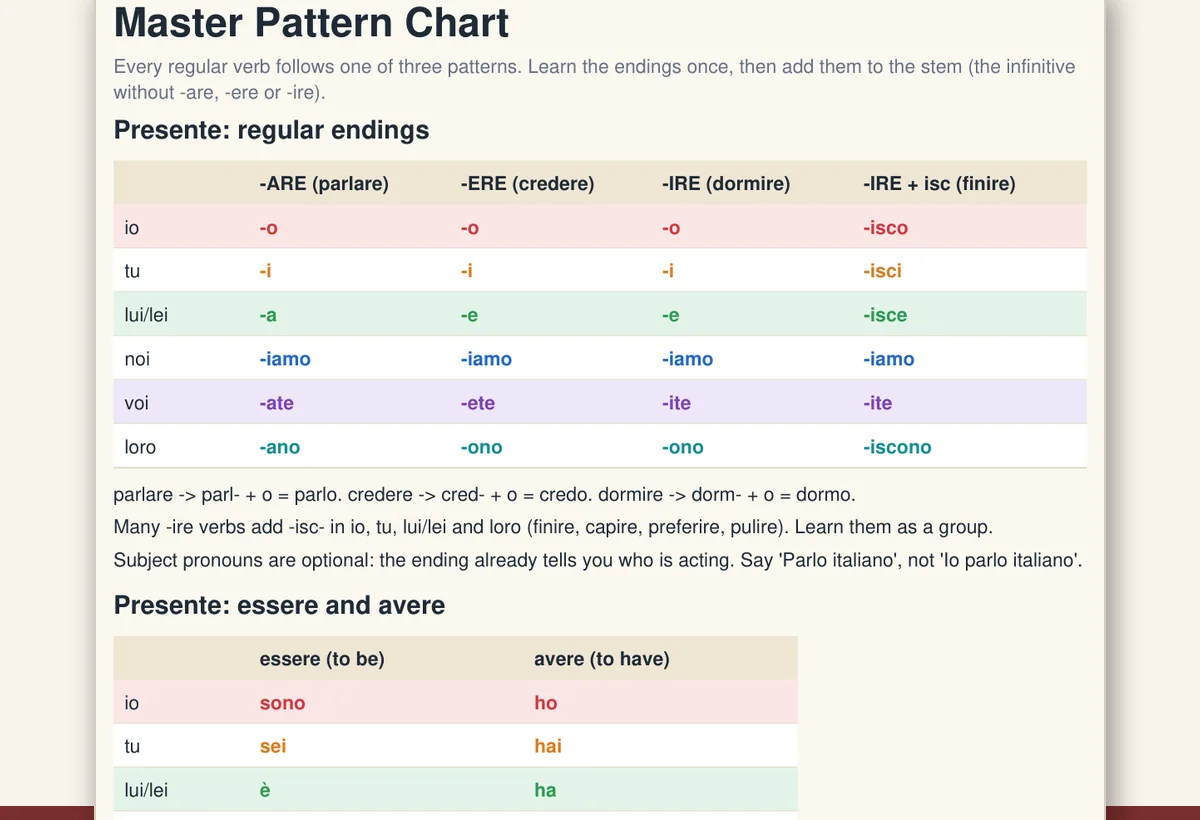
You do not need fluent Italian to travel well; you need about a dozen verbs you can say without thinking. With them you order, ask, pay, get on the right train and chat a little with the person next to you. This guide picks the verbs and the sentences, and shows how the verb pages in Verbi Chiari · Italian Verb Map Bundle fit into the weeks before a trip.
The twelve verbs
| Verb | Meaning | Trip sentence |
|---|---|---|
| andare | to go | Vado a Firenze domani. |
| venire | to come | Vengo da Boston. |
| volere | to want | Voglio un caffè, per favore. |
| potere | to be able to | Posso pagare con la carta? |
| avere | to have | Abbiamo prenotato un tavolo. |
| essere | to be | Sono qui per tre giorni. |
| prendere | to take | Prendo il treno delle nove. |
| comprare | to buy | Vorrei comprare un biglietto. |
| pagare | to pay | Pago io. |
| cercare | to look for | Cerco la stazione. |
| capire | to understand | Non ho capito. |
| parlare | to speak | Parla più lentamente, per favore. |
Say each sentence aloud. They are short, polite enough for any counter and made from verbs you can change by person.
Getting around
Andare and prendere carry transport. "Vado alla stazione." "Prendiamo il treno." "Dove vai?" For the past, remember that andare uses essere: "Siamo andati a Venezia in treno." For the future: "Domani andrò in spiaggia."
Cercare and trovare handle finding things. "Cerco un bar." "Ho trovato l'albergo."
At the restaurant
Volere, prendere and bere do most of the work. "Voglio il tavolo vicino alla finestra." "Prendo la pizza." "Beviamo un'acqua." For the bill, "Posso pagare con la carta?" or "Il conto, per favore".
The polite conditional vorrei ("I would like") deserves a place in your head even though it is outside the four tenses. It is a useful phrase to memorize whole.
Understanding and being understood
Capire is your safety net. "Non ho capito" (I did not understand) and "Capisco un po'" (I understand a little). It is an -ire verb with -isc-: capisco, capisci, capisce, capiamo, capite, capiscono. Parlare helps you ask for a slower pace.
Telling a story
On a trip you talk about what you did, so the passato prossimo is the most useful tense after the present. Practice a quick recap: "Ieri sono arrivato a Roma. Ho visto il Colosseo. Ho mangiato una pasta buonissima." Check the helper for each verb, because arrivare takes essere and vedere and mangiare take avere.
For a habit or scene, use the imperfetto: "Mentre mangiavo, è arrivato Luca."
A six-week plan
| Week | Focus | Practice |
|---|---|---|
| 1 | essere, avere, andare | Introduce yourself and say where you are going |
| 2 | volere, potere, prendere | Order a meal and ask a question |
| 3 | comprare, pagare, cercare | Buy a ticket and pay |
| 4 | capire, parlare | Ask for help and slower speech |
| 5 | Past tense | Retell your day |
| 6 | Mixed | Role-play a day from breakfast to dinner |
Ten minutes a day is enough. The verb pages give you the forms; you supply the scenes.
Carry less, know more
Print only the pages you need and take them in a slim folder or as PDFs on your phone. The color by person helps when you glance at a page in a hurry, and the three example sentences are phrases you can actually use.
Add the themed vocabulary sheets for food and travel, so you have the nouns to go with the verbs. A phrase sheet set is sold separately if you want ready-made lines, but the verbs and vocabulary let you build your own.
Be realistic
This is a study aid, not a course. Italians will often answer fast and in their own way, and you will not catch everything. A dozen well-practiced verbs make those moments easier, and they show you are trying, which opens more doors than perfect grammar.
Before you go: a checklist
- Say the io form of all twelve verbs aloud.
- Say the noi form for the six you will use with a travel companion.
- Prepare five sentences for the restaurant and five for transport.
- Learn the past of andare, vedere, mangiare.
- Keep the pages for capire and parlare handy.
Three scenes to rehearse
Scene 1: The coffee bar. "Buongiorno. Prendo un caffè e un cornetto, per favore." Then, to pay: "Quanto costa?" and "Posso pagare con la carta?" Verbs: prendere, costare, potere, pagare.
Scene 2: The train station. "Vorrei comprare un biglietto per Firenze." "A che ora parte il prossimo treno?" "Da quale binario?" Verbs: volere, comprare, partire. Remember that partire takes essere in the past: "Il treno è partito".
Scene 3: Dinner with new friends. "Di dove sei?" "Vengo da Chicago." "Che cosa fai nella vita?" "Lavoro in un ufficio." "Ieri siamo andati al mare." Verbs: essere, venire, fare, lavorare, andare.
Rehearse each scene aloud three times, then swap the persons: noi for a couple, voi for a table of friends. If you can handle those three scenes, you will manage most days.
After the trip
Do not put the pages away when you land back home. Keep a note of the phrases you used, the ones you wished you had and the ones that made someone smile. Add them to a page of your own. If you plan another trip, you start from a stronger base: the verbs already feel familiar, and your list of useful phrases is built from real moments instead of guesses.
The most common regret of travelers is not having said more. A dozen verbs, practiced for a few weeks, move the line a little further each time, and every small success makes the next sentence easier to start.
Open the sample page above to see how one travel verb looks on a map, and picture the other eleven in your folder before the flight.